Just before he set off to Palestine on the Third Crusade, in about 1190, King Richard the Lionheart granted to the Knights Hospitaller of St. John of Jerusalem some lands in Herefordshire, including Wormbridge, Callow and Dinmore. According to a fifteenth-century writer, this meant that when he got to the near East, the brethren of the order were kind and helpful to him, fratres cum at terram sanctam ipse rex transmearet plurima beneficia ac commode sibi et suis contulerunt. Not much is known about the previous history of the area, but it seems likely that it formed part of the royal forest of Treville, which already existed in the reign of Edward the Confessor, and it is possible that there was some sort of earlier church on the site, since Christianity was already well-established in Herefordshire in the Dark Ages.
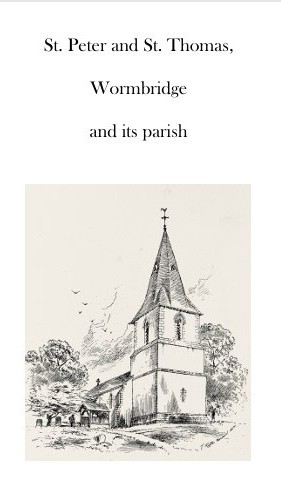
The local landowners who had been leasing it appear to have acquired the freehold during the 1530s; from them it passed in 1609 to a London linen-draper who wanted to retire to the country. The lord of the manor became 'lay rector', appointing a chaplain as the Hospitallers had done. During the Interregnum the family sided with the Roundheads, unlike most of the Herefordshire gentry, and seem to have maintained a curate with very advanced Baptist opinions. In 1771 the lay rector also acquired the advowson of the neighbouring parish of St. Devereux, and from that point on the churches were served by the same person as rector of St. Devereux and curate of Wormbridge, although they were not formally united until 1849. The Victorian landowner was himself a clergyman, and, though he did not appoint himself as curate, he sometimes took services and was much involved in the restoration and refurbishment of St. Peter's, and also of the nearby churches of Kilpeck and Thruxton. In the 1830s a school was founded nearby which became Wormbridge Church of England Primary School (closed in 2012).
By the 1970s the Church of England began to appoint priests-in-charge and to lump rural parishes into larger groups. In the early twentieth century these two small parishes were served by the same clergyman as Kilpeck; later the three formed part of the Ewyas Harold group of parishes. In 1994 a milestone was reached when the Reverend Clare Garrett was appointed as the first woman priest in the district. Recently, the parishes have been moved to the Twin Brooks group, along with Kingstone, Thruxton, Eaton Bishop, Allensmore and Clehonger. The maintenance of these many small ancient parish churches, several of which are listed Grade I, is a heavy burden on a thinly-populated rural district. In several cases, the church represents the only communal space in a scattered rural community; its spiritual importance is equalled by its social significance.
St Peter and Thomas, Wormbridge and Its Parish © Dr Charlotte Mitchell
is available to buy in the church
If you have found this site of interest we would be most grateful for any contribution you could make to the funds needed for the urgent conservation work Donate Here